


Travess Smalley: Pixel Rugs opens at Galerie Met in Berlin on Friday, November 13, 2026, with an opening from 6 to 9 p.m., and runs November 14 through December 5 at Mariannenstrasse 33. Curated by Kika Nicolela in collaboration with objkt, the solo show gathers one long-running project in every form it has taken: digital Pixel Rugs minted on Tezos, process animations, prints, hand-knotted wool rugs, and Pixel Rugs, Smalley’s first monograph from Vetro Editions.
The reason to pay attention is not novelty. Smalley has been building these images out of tiny pixel grids since 2018–19, and the show asks a question many onchain artists keep running into: what happens to a screen-native image when it has to live in ink, paper, or wool? His answer, drawn from his great-grandmother’s quilting table as much as from video games, is one of the clearest you will find.
What Pixel Rugs is
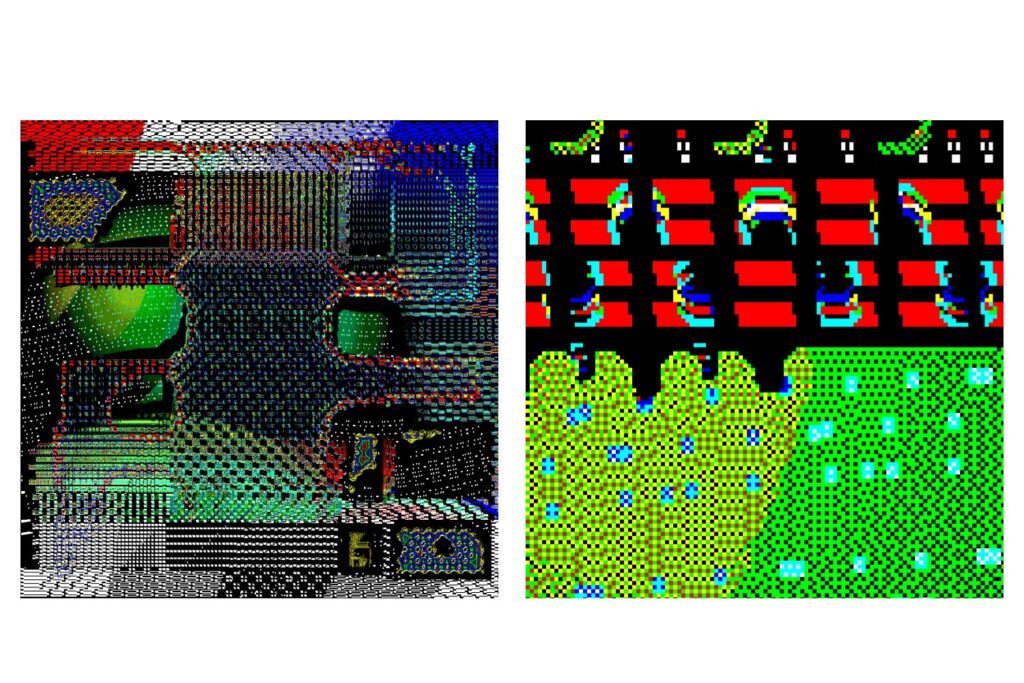
Galerie Met describes Pixel Rugs as an exploration of “the pixel as both a digital building block and a unit of pattern.” Smalley uses Photoshop as a generative tool, layering, rotating, and transforming small grids so the results are “at once systematic and unpredictable.” Individual pieces are minted as NFTs on Tezos, and the gallery calls that body of tokens “a digital record of its development.”
According to Vetro Editions, the project is rooted in generative pieces Smalley released on the Tezos platform hic et nunc “during the explosive spring of 2021,” and he continues to release them on Teia, the community-run successor. If you were around for that moment, our early hic et nunc buyer’s guide is a time capsule of the scene these rugs came out of.

How a Pixel Rug gets made
In a long interview with curator Kika Nicolela published by Galerie Met ahead of the show, Smalley walks through the process. “A rug starts with a small grid, anywhere from 8 by 8 to 128 by 128 pixels,” he says. He assigns RGB colors to a set of dither patterns, then overlays, stacks, rotates, and blends them. Rotating one small pattern over another “by a fraction of a degree produces new patterns on its own,” and scaling the image up and down changes it again through quantization.
He works hand-first rather than code-first. Most discoveries come from noticing an effect, then “reverse engineering it into a script,” a habit built over a decade of Photoshop Actions and AppleScript. The results are named by date, like 10_07_26_Pixel_Rug_01, which makes the series read like a diary of his eye. He thinks of himself as a player inside the software: “The finished rug is the document of the playthrough, the final state of the board.”
From Appalachian quilts to a pixel grid
Smalley was born in Huntington, West Virginia, in 1986, and the textile side of the project came from home. He traces it to four things coming together: the game designer Derek Yu’s pixel art tutorials, Appalachian and Shaker textiles seen on trips back to West Virginia, the way color changes when tiny images are scaled, and Minecraft players laying out blocks as flat pictures. The first images, he says, were Shaker- and Appalachian-inspired patterns he made in Photoshop to furnish his Minecraft houses.
My great-grandmother gave her whole living room over to a large quilting table. When we visited, the family huddled in whatever parts of the house weren’t covered in quilts. That was just the furniture of my childhood.
Travess Smalley, in conversation with Kika Nicolela
Research made the family link click. He found the watercolor records of weaver and archivist Frances Louisa Goodrich, which note each pattern numerically, and recognized designs he had grown up around. He calls them “scripts, manifests for how to make a pattern,” which is a neat description of what a generative artist writes, too.
Wool, ink, and a book that glows
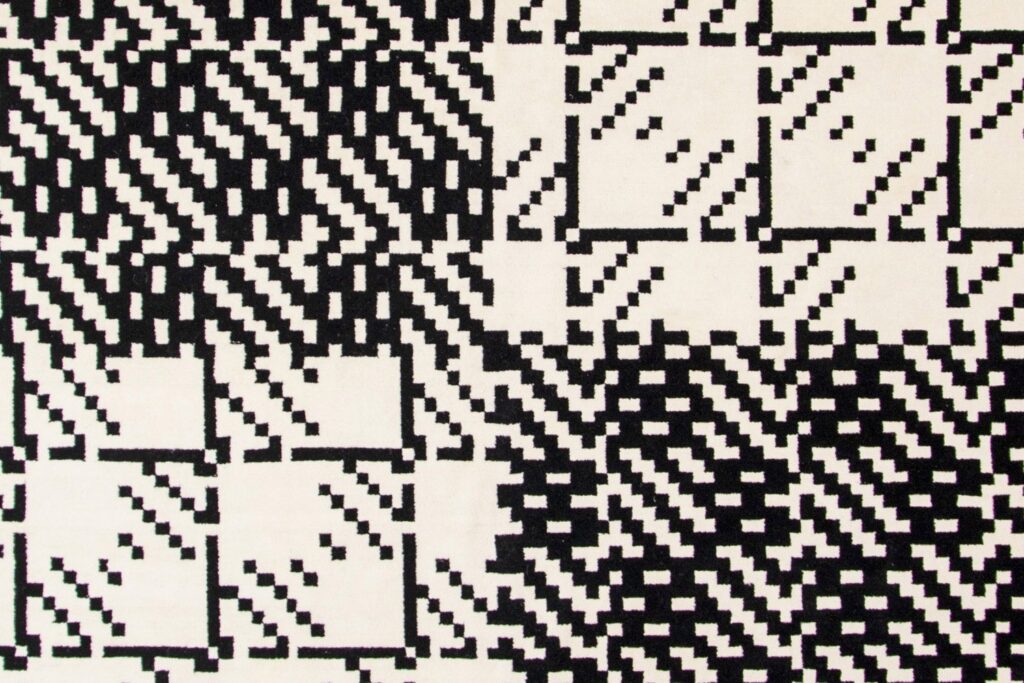
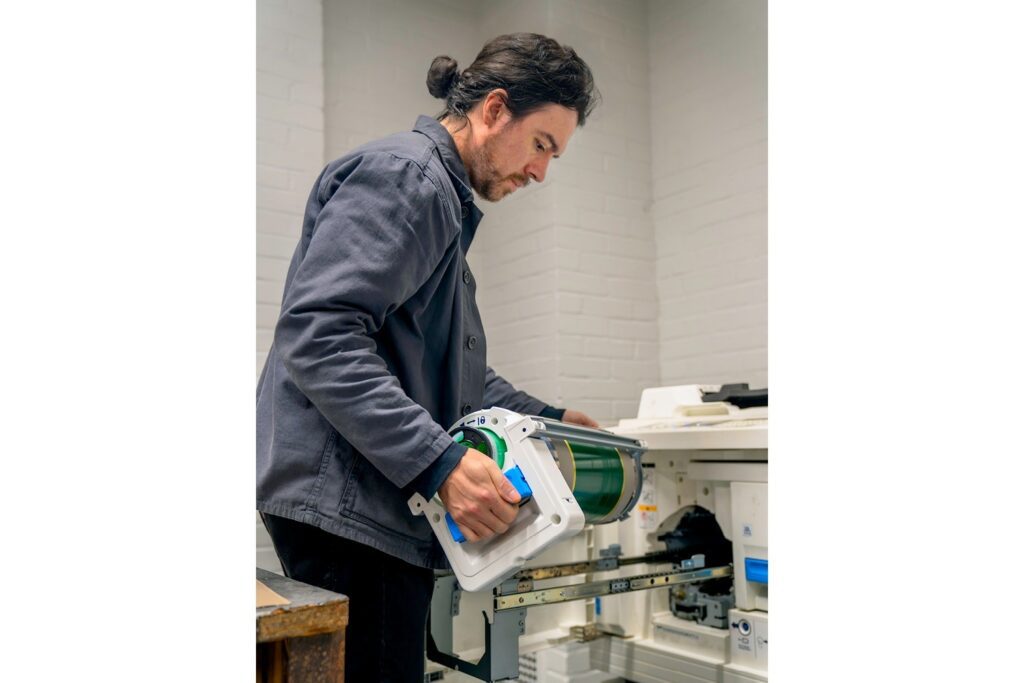
The Berlin show is built around translation. Smalley says pixels per inch become dots per inch, then toner, risograph ink, and finally “knots per inch.” The wool rugs are woven by a studio in Bhadohi, India, that converts his image into a weaving map, and he credits the mapmakers and weavers by name with each rug. “Pure RGB can’t exist in wool or ink,” he says, “and I don’t experience that as loss.” The exhibition also debuts a new format for the project, UV prints on Dibond, alongside projected animations that show rugs being generated step by step.
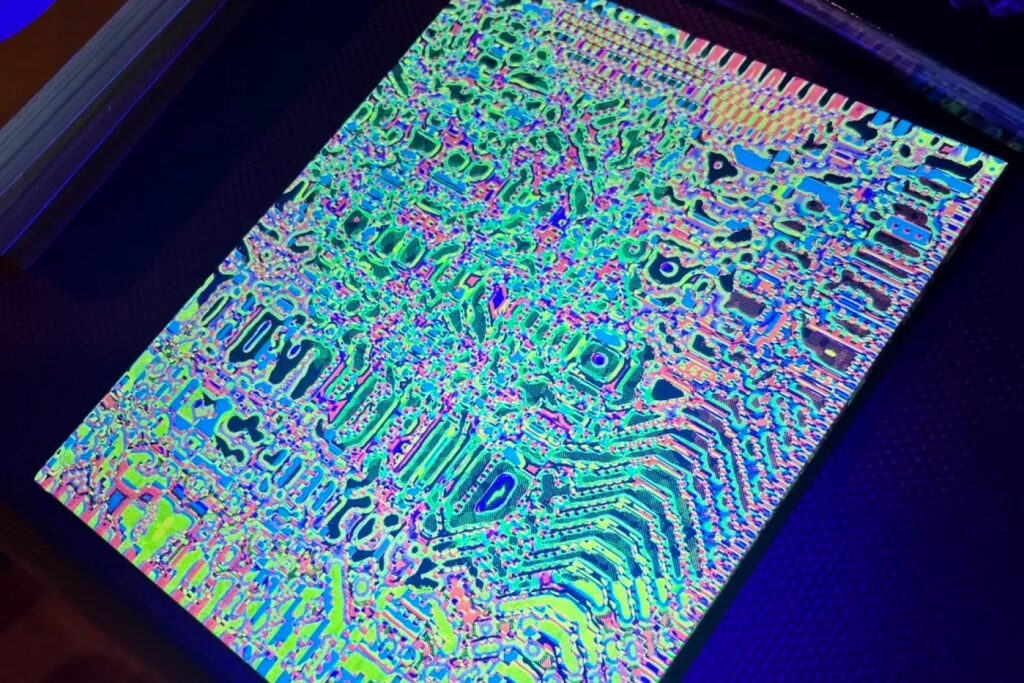
The monograph pushes the same problem onto the page. Per Vetro Editions, Pixel Rugs runs 192 pages, is printed in Quadrifluox, a five-color offset process using four fluorescent inks plus Pantone 812 C, and reacts under UV light. It includes essays by Casey Reas, co-creator of Processing, and curator Anika Meier. Galerie Met is also listing an exhibition edition of 10 with a special dust jacket. Smalley says the book “now has two readings”: under UV, certain colors jump forward and different structures surface.
Why it matters for onchain artists and collectors
Pixel Rugs is a useful model for how an NFT can sit inside a wider practice instead of being the whole story. Smalley calls the token “the archive: a document of a moment, and the digital map the physical works are made from.” He is also frank about its limits: “IPFS isn’t permanent either,” he says, calling it “one more external place for the work to live.” He points to every rug sitting on one contract as “a through line you can follow from the first mint,” and says you can read the platform’s own history in the gaps between his mints.
There is a collector lesson here as well. Smalley credits Basha, one of his earliest collectors, with a thread that sorted his practice into periods, “an interpretation that hands you a new read of your own work.” A long, dated series rewards that kind of close looking, and a gallery show that puts screen, print, and wool side by side makes those shifts visible in one room.
The project also has a deep art-world lineage. Smalley’s path ran through Cory Arcangel, Processing, and the net artists of the 1990s, the history we traced in Rhizome’s net art at 30. Galerie Met notes that his work is held by the Bibliothèque Kandinsky at the Centre Pompidou, ZKM, the High Museum of Art, and the MoMA Library, which fits the broader institutional turn we covered in the Pompidou’s new digital art committee.
Visit Travess Smalley: Pixel Rugs
- Where: Galerie Met, Mariannenstrasse 33, 10999 Berlin.
- Opening: Friday, November 13, 2026, 6–9 p.m.
- Dates: November 14 – December 5, 2026. Gallery hours are Tuesday to Saturday, 11 a.m. to 6 p.m.
- Curator and partner: Kika Nicolela, in collaboration with objkt.
- Read more: the full Galerie Met interview, the Vetro Editions book page, and the artist’s website.
For more artists working between code, craft, and institutions, browse our NFT art coverage and generative art archive.