


CrypToadz by Gremplin is a collection of 6,969 pixel-art toads on Ethereum, released in September 2021 by the pseudonymous artist Gremplin and placed in the public domain. Its official collection description says it plainly: “This project is in the public domain. Feel free to use the toadz in any way you want.” Five years on, that one sentence explains why CrypToadz still matters. The toadz were never just a profile-picture set. They were an open invitation, and people took it, including a community-built contract that redraws every toad directly on Ethereum.
This entry in our Behind the Bluechips guide to legacy NFT artists looks at what CrypToadz actually is: the art and the swamp lore, the CC0 decision, what got built on top of it, and why a public-domain collection reads differently in a year when so many NFT platforms have closed.


What CrypToadz by Gremplin is
The CrypToadz contract went live on Ethereum on September 8, 2021, according to its on-chain creation record. The official site credits the work to Gremplin, and the collection description adds that it was “created by Gremplin, with a little bit of help from his friends.” Each toad is a small, scruffy pixel creature built from traits like bodies, heads, mouths and accessories, and each token’s metadata describes it the same way: “A small, warty, amphibious creature that resides in the metaverse.”
Gremplin works under that name only, and we don’t speculate past it. The official bio says he arrived “on a January evening in early 2021,” first made spinning boxes and rotating characters, and has been “drawing residents of lands, be they Nouns or Toadz” ever since. That Nouns line is literal: Gremplin is listed among the founders of Nouns on the Nounders page at nouns.wtf. His own gallery index on Deca also lists an earlier CC0 collection, Rekt Cats, from May 2021, so the public-domain choice for CrypToadz was a practice he already had, not a one-off.
The lore: Uniswamp, the Croakening and Colonel Floorbin
CrypToadz launched with a story instead of a roadmap. According to the official site, the toadz lived in a swampy basin once called Uniswamp until the Evil King Gremplin descended, exiled their leader Colonel Floorbin to Gooch Island, renamed the land Grempland and ruled with an army of Fronkz. The toadz call his reign “The Croakening.” The mint itself was framed as a rescue: collectors chose “how many to free during minting.”
It is crypto humor written as a fairy tale.
Uniswamp riffs on a decentralized exchange, Colonel Floorbin on the trading slang of 2021, and the villain is the artist himself.
That self-mocking tone is a big part of the CrypToadz culture. It made the project feel like an inside joke you could join rather than a brand you had to buy into.
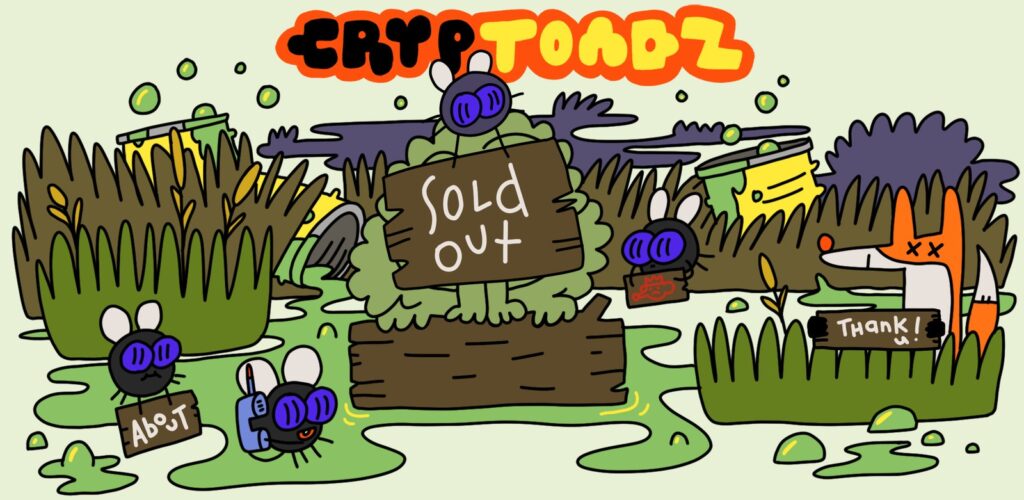
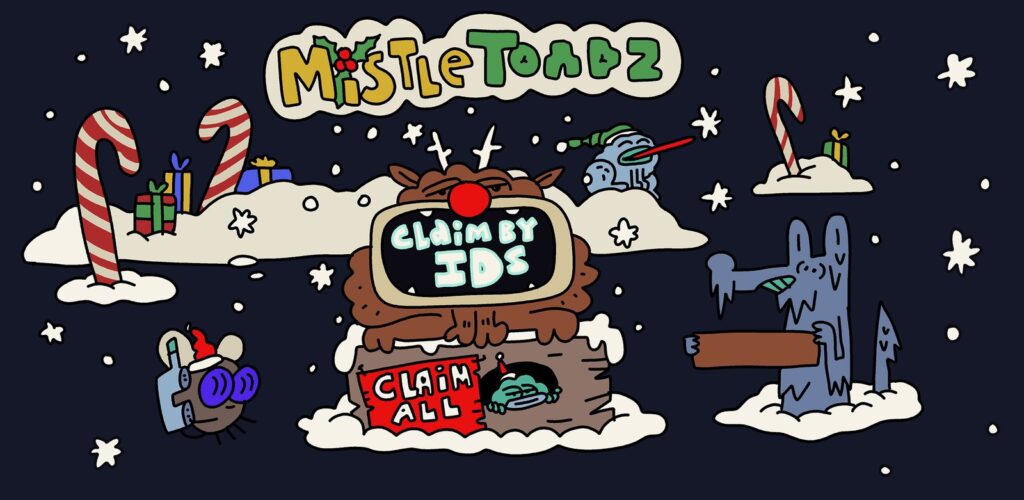
The story kept going. A few months after launch, the MistleToadz claim page picked it up: the freed toadz were “preparing for a Christmas attack on Grempland,” and holders could help “by clicking claim.” Gremplin’s gallery index lists MistleToadz as a claimable holiday gift for the collection, alongside other works like Cryptoadettes and Howlerz.
Why CC0 made CrypToadz a creator’s collection
CC0 is a Creative Commons tool for waiving copyright and placing a work in the public domain. For an NFT collection, that changes who gets to build. Owning a toad still means owning that token, but the images themselves are free for anyone to remix, print, animate or build on, holder or not. The toad becomes shared material rather than licensed property.
That is different from how most 2021 PFP brands grew up. Projects like Azuki took the route of a managed world, with an official manga and a trading card game, as we covered in Azuki Beyond the PFP. Invisible Friends shows the other end of that model: this month a new owner bought the whole project and is moving it to a new contract. With CrypToadz, the art has no copyright to buy. Anyone can pick it up.
The derivative that matters most: CrypToadz Chained
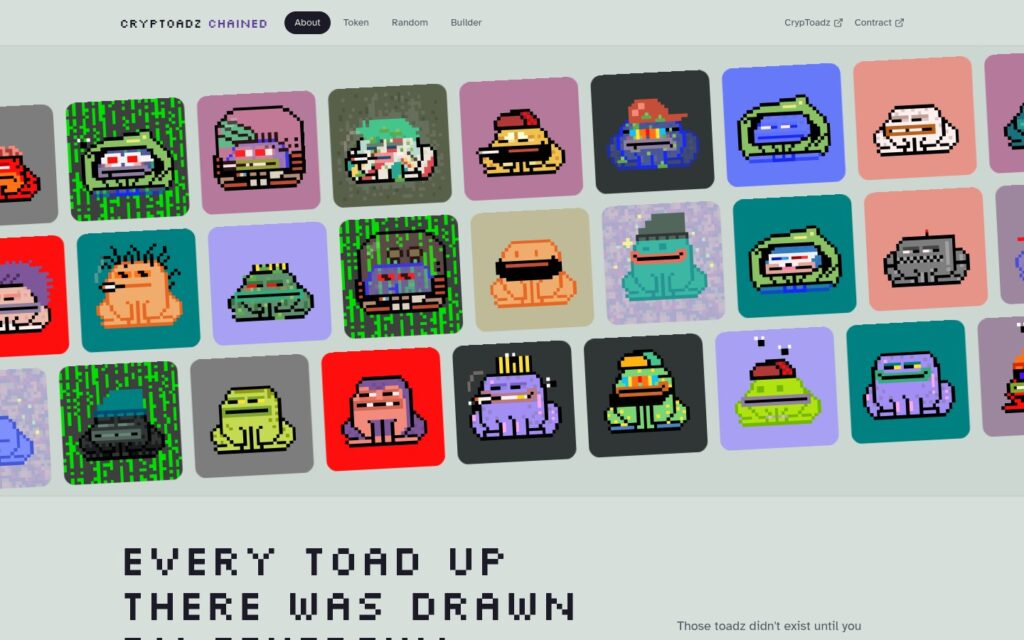
The clearest example of what that openness allows is CrypToadz Chained, a community project that rebuilds every toad inside an Ethereum smart contract. Its site explains the problem it solves: ask the original CrypToadz contract what a toad looks like and it returns a link to a file on Arweave, a decentralized storage network. (When we checked, toad #1’s link still loaded.) That works only as long as someone keeps a gateway up to serve the file.
The Chained contract answers the same question with the toad itself. According to the project, each trait is stored on-chain as compressed drawing instructions, painted onto a 36-by-36-pixel canvas and encoded as a GIF by code written in Solidity. The one-of-ones and animated toadz are stored whole. The team says two separately written validators compared every image and metadata file with the originals pixel by pixel. It also makes a point collectors should understand: the Chained contract holds no tokens and can’t move one. Ownership stays with the original contract. The source code is published under a CC0 license too, and the contract has been on Ethereum since August 2022, according to its creation record.

There is one honest limit. Wallets and marketplaces still read the original contract’s Arweave link, so a toad doesn’t use the on-chain copy automatically. The Chained project says that would need apps to support web3:// links, which most don’t yet. Still, the art now exists somewhere that doesn’t depend on any one company or server, and that happened because the license allowed it.
Why CrypToadz matters in 2026
This has been a hard year for NFT venues. Nifty Gateway shut down in February, and Foundation announced it was winding down in April. Each closure raised the same question for artists and collectors: when the platform goes away, what happens to the work?
CrypToadz is one of the best answers the 2021 era produced. The art sits in the public domain. Its images live on decentralized storage, and a community copy lives on Ethereum itself. The lore is written on an official site anyone can still read. None of that depends on a marketplace staying open or a company staying solvent. For creators, the lesson is that a license can outlast a venue. For collectors, the takeaway is to check where a collection’s art is actually stored and what its license lets other people do. Those two answers say more about whether a project will last than any launch-week buzz.
Five years in, CrypToadz feels less like a profile-picture project and more like a shared swamp anyone is free to visit. For more of the collections and artists that shaped NFT culture, browse the Behind the Bluechips series.
Sources
- CrypToadz by Gremplin: official site (lore and Gremplin bio)
- MistleToadz by Gremplin: official holiday claim page
- CrypToadz by Gremplin: official collection description on OpenSea (public-domain statement)
- Etherscan: CrypToadz contract (creation record)
- CrypToadz Chained: how the on-chain copy works
- CrypToadz Chained source code on GitHub (CC0)
- Nouns DAO: the Nounders
- Gremplin’s gallery index on Deca