


The Pompidou Digital Art Committee is a new five-year patrons’ circle, running from 2026 to 2031, that will pay for the Centre Pompidou to acquire, conserve, research, publish, and exhibit digital art. The Paris museum says the committee will pay particular attention to onchain art, meaning works created and registered on a blockchain, and to new forms of generative art. Its founding patrons are Ismail Tazi and Benjamin Gross. The Paris building is closed for renovation until 2030, so for now the collection is on view in Shanghai, at the Hamburger Kunsthalle from November 20, and online.
Below is what the museum actually announced, how it fits a collecting history that goes back to the Pompidou’s 2023 blockchain acquisitions, where you can see these works over the coming months, and what it means for artists and collectors who care about onchain work lasting longer than the platforms that sold it.
What the Pompidou announced
According to the Centre Pompidou’s press release, the committee “seeks to bring together French and international patrons who wish to support the institution in its commitment to digital art.” In practice it has three jobs:
- Acquisitions: buying works for the collection of the Centre Pompidou – Musée national d’art moderne.
- Sharing the work: supporting publications, research programmes, and exhibitions.
- Conservation: funding the care of works, “taking into account their artistic and technical specificities.”
The release lists Xavier Rey, the museum’s director, along with Marcella Lista, head of the New Media department, and Philippe Bettinelli, a curator in that department. The museum says the committee adds to, rather than replaces, the support it already gets from the Friends of the Centre Pompidou. It calls the idea a “collective mobilisation of art collectors and key members of the digital scene,” aimed at “creating sustainable ties between the museum and the communities dedicated to these practices.”
One founding patron is a familiar name in onchain art. In his speaker bio for The Art Business Conference, Benjamin “Benny” Gross, known to collectors as RedBeard, is described as a founding patron of the committee and a member of the Whitney Museum of American Art’s Digital Art Selection Committee. The release does not publish membership terms, contribution levels, or a list of planned acquisitions, so we won’t guess at them.

How the committee builds on the 2023 NFT acquisitions
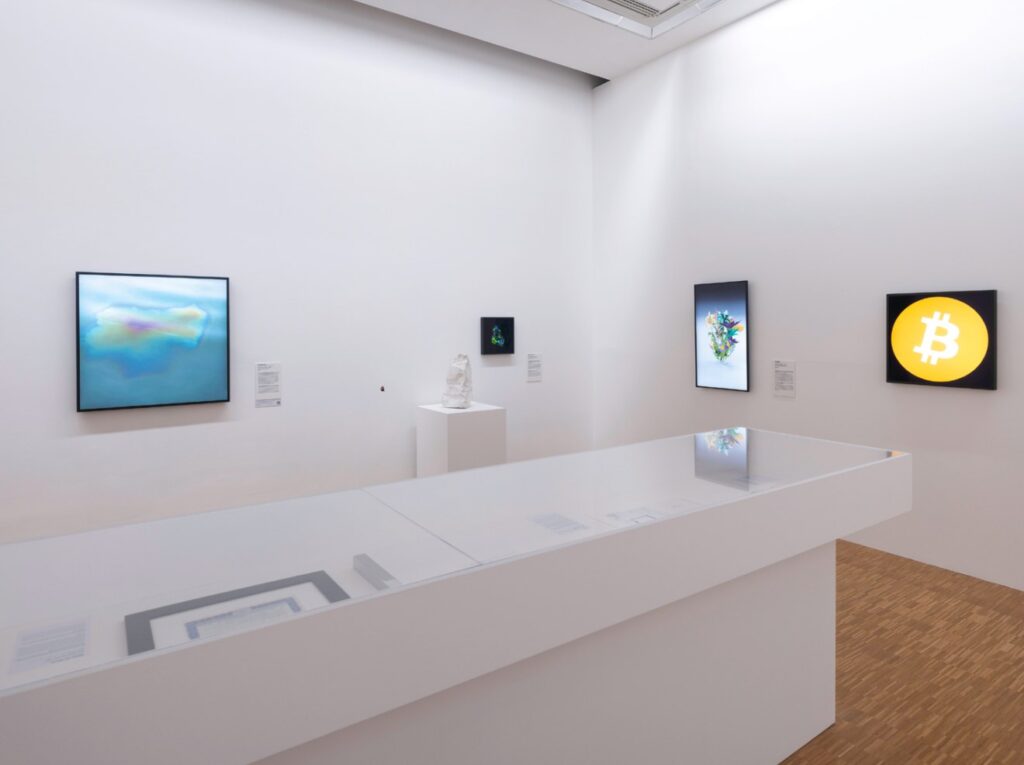
The committee is a new step, but the Pompidou has been collecting this work for years. In February 2023 the museum announced that 18 blockchain-related projects by 13 French and international artists, which joined the collection by donation or purchase. The list included Larva Labs’ CryptoPunk #110 and Autoglyph #25, Sarah Meyohas’s Bitchcoin, Rafael Rozendaal’s Horizon works, John F. Simon Jr.’s Every Icon #419, Jonas Lund’s Smart Burn Contract (Hoarder), Jill Magid’s Hand-hacked Bouquet 1, and pieces by aaajiao, Émilie Brout and Maxime Marion, Claude Closky, Fred Forest, John Gerrard, Agnieszka Kurant, and Robness.
Even then the curators drew a clear line. The 2023 press release said the goal was “not so much to focus on the cultural phenomenon of ‘collectibles'” but on “the most daring creative uses of these technologies.” That explains the mix: a CryptoPunk sits next to conceptual contract works and net art pioneers, chosen as art history rather than as a market index.
The new release says works by Robert Alice, Rhea Myers, and Anna Ridler have since entered the collection. The French-language announcement, as reported by The Art Newspaper France, also cites the gift of a significant group of generative works by Tyler Hobbs. The museum frames the committee as part of a much longer story: ARTA, a computer research studio for artists and the public set up in 1975, and exhibitions such as Les Immatériaux (1985) and the Mutations/Créations series (2018–2022).
Where to see the Pompidou’s digital art while Paris is closed
This is the practical part most coverage skips. The Hamburger Kunsthalle notes that the Centre Pompidou is closed until 2030 for renovation, so the collection is touring. The museum’s announcement points to three exhibitions in its Constellation programme:
- Computer Worlds, September 24, 2026 to February 14, 2027, Centre Pompidou × West Bund Museum Project, Shanghai (Gallery 3, 2600 Longteng Avenue; open Tuesday to Sunday, 11 a.m. to 6 p.m.). Nearly 180 works and archival documents trace digital creation from the 1950s to today. One of its seven sections, “Flows and Networks,” covers internet art and NFTs, according to the West Bund Museum.
- Unstable Media in the 21st Century, November 20, 2026 to May 2, 2027, Hamburger Kunsthalle. It shows about 40 key works from the Pompidou’s New Media Collection in eight chapters. The artist list includes Robert Alice, Rhea Myers, Sarah Meyohas, Claude Closky, and Holly Herndon & Mat Dryhurst, so onchain practice sits alongside video and installation rather than in a separate NFT room.
- Nos chimères sont-elles ce qui nous ressemble le mieux ? (“Do Our Chimeras Most Resemble Us?”), an online exhibition with KADIST, through December 13, 2026. Ten artists look at large language models and generative AI.

The curators are also showing up in onchain art spaces. Philippe Bettinelli was on the schedule for an institutions panel at Art Blocks Marfa Weekend 2026, “The Next Hundred Years: How Art Institutions Are Adapting To A Changing Landscape,” alongside speakers from LACMA, MoA+L, and NODE.
What the Pompidou Digital Art Committee means for creators and collectors
For artists: the committee’s focus on onchain art matters because the Pompidou has been specific about the term. Its 2023 press release explained that most NFTs point to a file stored elsewhere (“off-chain”), while onchain works keep all of the artwork’s data in the token itself. In a 2023 interview, the curators compared NFTs to the videos the museum acquired in the 1960s: “Our mission continues to be to ensure the transfer of works from a technology on the wane to a new one.” If you want your work to hold up under that kind of review, your contract, your storage choices, and your documentation all count, and a committee that funds conservation puts money behind that question. Generative artists can also see the Hobbs gift and the 2023 Autoglyph acquisition as signs of where the museum’s interest already lies.
For collectors: this is a patronage model, not a fund buying on marketplaces. The museum’s own curators and acquisitions process still decide what enters a national collection, as they did in 2023. For people who own important works, donation has been a real path; CryptoPunk #110 joined the collection that way. The bigger signal is continuity. Alongside Rhizome’s long-running net art program and fair efforts like Art Basel Zero 10, a five-year museum commitment is another sign that institutions plan to keep blockchain art around after the platforms that sold it.

What to watch next
- The first acquisitions credited to the committee, and whether the museum names the artists and the chains they work on.
- Unstable Media’s opening in Hamburg on November 20, the first chance to see how the Pompidou places onchain works next to decades of video and installation.
- Whether more patrons are named as the committee grows beyond its two founders.
For more museum, gallery, and artist coverage, browse our NFT Art section.